



What is Digital Marketing
Digital marketing involves utilizing digital channels and technologies—mainly the internet, along with mobile applications, social media, search engines, and various other digital platforms—to advertise products, services, and brands, thereby establishing connections with prospective customers.
The Central Concept: Engaging the Appropriate Audience, in the Suitable Location, at the Optimal Moment
Unlike conventional marketing methods (such as television advertisements, billboards, or printed brochures),
Interactive: It facilitates two-way communication between a business and its target audience.
Extensively Measurable: Almost every aspect (clicks, views, purchases, etc.) can be tracked, providing a clear insight into return on investment (ROI).
Targeted: Messages can be directed towards very specific demographic groups based on their characteristics, interests, online activities, and geographical location.
Flexible and Adaptive: Campaigns can be modified in real-time according to performance metrics.
Types of Digital Marketing
Search Engine Optimization (SEO)
The procedure of enhancing your website to achieve a higher position on search engine results pages (such as Google) for pertinent keywords. The objective is to obtain “free” or “organic” traffic.
Content Marketing
Producing and disseminating high-quality free content (such as blogs, videos, infographics, and podcasts) to draw in and engage a specifically identified audience. The objective is to foster trust and loyalty.
Social Media Marketing (SMM)
Promoting your brand and content on social media platforms (Facebook, Instagram, LinkedIn, TikTok, etc.) to increase brand awareness, drive traffic, and generate leads.
Pay-Per-Click Advertising (PPC)
Placing online ads and paying a fee each time someone clicks on them. The most common type is search engine advertising (like Google Ads).
Email Marketing
Sending emails to prospects and customers to nurture relationships, promote content, offer discounts, and drive sales. It’s one of the highest ROI channels.
Affiliate Marketing
Partnering with other people or companies (“affiliates”) who promote your product for a commission on each sale they generate.
Marketing Analytics
The practice of measuring, managing, and analyzing data from marketing campaigns to understand their effectiveness and optimize for better results.
How Digital Marketing Works
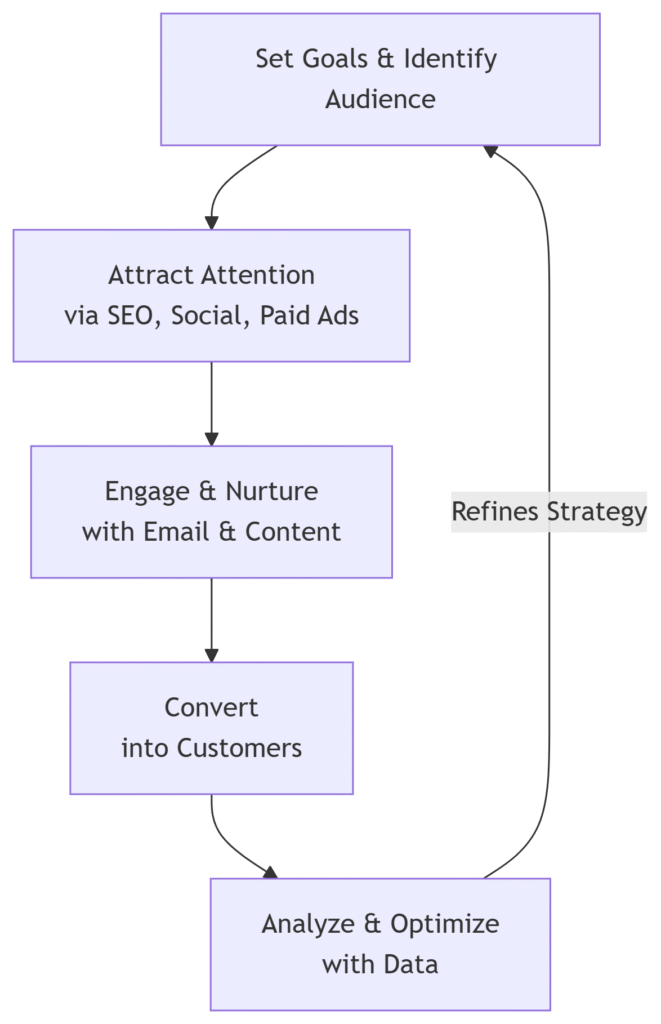
Step 1: Goal Setting & Audience Identification
-
- Goals: What do we want to achieve? (e.g., more sales, more website visitors, more app downloads, better brand awareness).
- Target Audience: Who are we trying to reach? (e.g., “college students aged 18-24 interested in budget travel,” or “IT managers in large tech companies”). This involves creating detailed buyer personas.
- Step 2: Attract Attention (Awareness)
-
- SEO: You create content around keywords they search for, so your site appears in Google results.
- Social Media Marketing: You post engaging content on platforms (Instagram, LinkedIn) where they hang out.
- PPC Advertising: You pay to place ads directly in front of them on search engines or websites they visit.
- Content Marketing: You write a blog post or make a video that solves a problem they have.
Step 3: Engage & Nurture (Consideration)
- Email Marketing: They sign up for your newsletter. You send them helpful tips, product news, and special offers to stay connected.
- Retargeting Ads: They visit your website but leave without buying. Later, an ad for that exact product “follows” them around the internet, reminding them of it.
- Social Media Engagement: You respond to their comments, run live Q&A sessions, and create a community.
- Step 4: Convert (Action)
- Calls-to-Action (CTAs): Buttons or links that say “Buy Now,” “Sign Up,” or “Get a Quote.”
- Landing Pages: A dedicated page designed to remove distractions and make it extremely easy to complete that one action.
- The Purchase: All the nurturing leads to this moment—a sale, a subscription, a downloaded demo, etc.
- Step 5: Analyze & Optimize (Measurement)
- Analytics Tools: Software like Google Analytics tracks everything: who visited, where they came from, what they clicked, and if they bought anything.
- Key Performance Indicators (KPIs): You measure success against your goals using data (e.g., conversion rate, cost per acquisition, website traffic).
- Refinement: You see what’s working and what’s not. Then, you use that data to make smarter decisions. For example, if a certain ad isn’t leading to sales, you pause it and put your budget into a better-performing one.